
The accessibility of short-term holiday let sites like Airbnb, along with some favourable buy-to-let tax rules, mean that renting out property is a great opportunity to bring in extra income. We’ve prepared this guide to explain what this might mean for declaring and paying tax on any earnings you make from a property rental, and ways that you may be able to save money.
Am I allowed to rent my property as a holiday let?
Maybe. Whether you’re looking to let the whole property or just a bit of it, if it’s mortgaged you’ll need to check your lender’s terms and conditions around renting it out to anyone.
Some lenders can be very specific about what they allow, and breaking their rules can have very harsh – not to mention expensive – consequences. Having said that, if you’re honest about your plans, many mortgage providers will consider requests on a case-by-case basis (though this might be subject to additional fees).
Generally speaking, short term lets aren’t a problem. If you plan to rent out the property for longer periods then you may need to switch mortgages. This is why it’s so important to check with your lender early on, and discuss your plans with them.
Also bear in mind that if you rent the property yourself, or if it belongs to a council or housing association, then subletting may not be permitted. So again, seek permission first.
Is Airbnb classed as being self-employed?
Not exactly, although it can depend on how you’re operating. Airbnb hosts are usually classed as receiving property rental income not self-employed (trading) income, so different tax rules apply (like not paying National Insurance on it).
Do I have to pay tax on Airbnb income?
Yes, you must declare any property or self-employment income and pay tax on it if the total amount you receive in a tax year is more than the £1,000 tax-free trading allowance.
What does the trading allowance mean for Airbnb rental income?
The trading allowance means that you can earn up to £1,000 of property income or as a sole trader each tax year, and you won’t have to declare this to HMRC. If you have both types of income (you’re a sole trader and you earn money from property) you’ll get a £1,000 allowance for each.
What happens if I earn more than the allowance?
You’ll need to register with HMRC, and declare the earnings that you make from renting out your property on Airbnb (or whichever method you might be using).
Will HMRC know about my Airbnb rental income?
Yes, there’s a very good chance they will! Platforms such as Airbnb fall under the digital platform reporting rules so they’re required to collect information about what you earn from renting out your property through the site, and then report this to HMRC. You’ll receive a copy of the data they pass on, so it’s crucial to ensure this is accurate.
How do I pay tax on Airbnb income?
To declare your income as a sole trader, you’ll need to register for Self Assessment by 5th October following the end of the tax year that you need to report income for. Once registered, you’ll need to submit Self Assessment tax returns and provide the details of all your earnings from that tax year, including anything you might already have paid tax on, such as wages from an employer.
It’s a bit different if you own the property through a limited company, so make sure you double-check all the deadlines which apply to you!
Making Tax Digital for Airbnb income
It’s worth mentioning that there are new rules which might affect the way you record and report property income and expenses. Making Tax Digital Income Tax will replace Self Assessment from April 2026 if your UK self-employed and property earnings are more than £50,000.
How much tax will I pay on my earnings from Airbnb?
Anything you earn over the Personal Tax Allowance (currently £12,570 for the 2026/27 tax year) will be subject to tax just like any other type of income – for now. From April 2027 individuals in England, Wales, and Northern Ireland will be taxed differently on property income earned personally.
The good news is that there are still plenty of allowances and types of tax relief that you might be able to claim to reduce your bill.
This is because the tax that you pay is based on your profits (what’s left after deducting any costs or expenses), rather than the total amount of income.
Claiming the trading allowance on your tax return
Remember that £1,000 trading allowance that we mentioned earlier? You might still be able to claim this, even after you register with HMRC. On your tax return you’ll be given the choice of claiming either the trading allowance or your expenses. You might also be able to claim the property allowance if you use the trading allowance on a non-property related business.
- If the expenses that you incur as a result of letting out property on Airbnb are less than the £1,000 allowance, it makes more sense to claim the allowance on your tax return, helping to reduce your tax bill by a larger amount.
- If your allowable expenses are more than the £1,000 trading allowance, claim those instead!
The Rent a Room Scheme and Airbnb
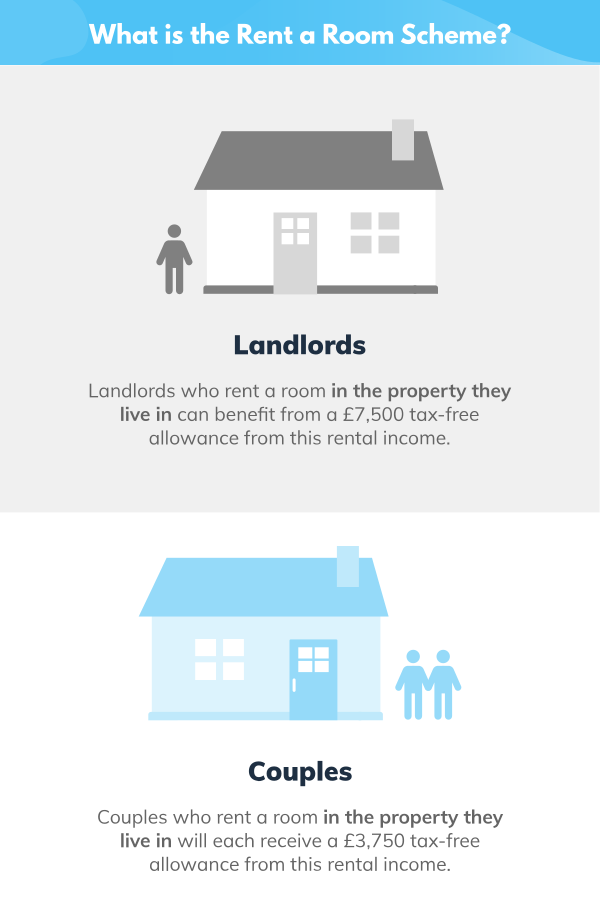
You might have a tax-free allowance separate to your main income if you rent a room on Airbnb. The Rent a Room Scheme can be claimed by anyone who rents out a room in the property they live in. It doesn’t matter whether the room being let is furnished or unfurnished.
Landlords letting out a room in this way can benefit from a further £7,500 tax-free allowance from this rental income. Obviously, the relief won’t be claimable by all Airbnb hosts, but it’s a valuable tax break for those who want to rent out just one room in their main residence.
An example of working out the Rent a Room Scheme
Mark earns £20,000 per year from his main job. As an employee he pays tax at 20% on anything he earns over his personal allowance (currently £12,570). In this case, the amount of income subject to tax is £7,430. His employer deducts the tax each time they pay him.
Mark also rents out a room in his house through Airbnb. Thanks to the Rent a Room Relief scheme, he can make an additional £7,500 maximum income and not need to pay any tax on it.
How it works for couples
Couples will often rent out a room in their home on Airbnb together. If this is the case, then the Rent a Room allowance is split equally between them into £3,750 each (as long as the room is inside a joint main residence).
For all other situations, for example if a group of friends own the house, then the Rent a Room relief cannot be claimed. That means tax will be due on the Airbnb income straight away.
What is Section 24 for landlords?
Section 24 refers to an update to UK tax laws dealing with the way tax is calculated for landlords. The changes mean landlords can no longer deduct mortgage interest and other costs (such as mortgage arrangement fees) from their rental income before working out their tax liability.
It’s significant, because deducting allowable expenses from income reduces the amount which is subject to tax, therefore reducing the tax bill.
Does my property qualify as a Furnished Holiday Let?
To answer this question, it’s important to know what a ‘Furnished Holiday Let’ actually is in legal terms. To be an FHL, your Airbnb must:
- Be located in the United Kingdom or European Economic Area (EEA)
- Have enough furniture available for everyday use
- Be displayed on the Airbnb website and be available to let for a minimum of 210 days of the year
- Be rented out as a commercial let to the public for 105 days per year or more
Do Section 24 tax rules apply to Airbnb?
Large numbers of Airbnb hosts are avoiding the Section 24 interest relief restriction because their properties are indeed Furnished Holiday Lets as discussed above. Section 24 rules come into force on properties not classed as FHLs.
The restriction essentially means that higher rate tax payers can’t claim full relief on their mortgage interest. Many people are finding it makes financial sense to move from traditional long-term letting to Airbnb, due to increased income but less tax.
What about Capital Gains Tax for Airbnb hosts?
If your property is a Furnished Holiday Let, and you don’t live there full time yourself, you can claim Capital Gains Tax relief. This may include:
- Access to capital allowances for property fixtures, fittings and furniture.
- Using the Gift Hold-Over Relief scheme to avoid paying Capital Gains Tax. This is where owners sell or give away any assets in their business for less than they are worth so that they can help the buyer.
- The chance to defer Capital Gains Tax liability when you sell one Airbnb residence and buy another one via the Rollover Relief scheme.
Don’t forget about VAT
Remember that if you earn £90,000 or more from your Airbnb rental in a 12-month period, you’ll need to register for VAT. You can decide to charge VAT to your guests directly by adding it on top of the rental rate, or you might simply choose to absorb the VAT yourself.
Alternatively, you could compromise by slightly increasing your nightly rate so that you bear some of the VAT burden, and share it with your guests. The advantage of this is that you don’t take the full financial hit, and your prices are still competitive. We have more guides explaining VAT in our resource centre.
Make your Airbnb project a success and discover our online accountancy services for property managers. Call 020 3355 4047, or get an instant online quote.
Want to learn more?
Subscribe to our newsletter to get accounting tips like this right to your inbox




Hi there
Airbnb has just informed me that the person who is named on the airbnb account has all the tax responsibility for income generated, even if a couple co-own the property and are co hosts. That means that only half the rent a room allowance can be claimed and any extra will be taxed at the account holders rate of tax. This was news to me. Is this your understanding?
Hi Peter
Thanks very much for your message. We’ve had a quick look into this and the general opinion is that it would normally need to be split based on legal ownership, although the information Airbnb report to HMRC as part of the Digital Platform Reporting Rules will be in the name of the host, and there may be Airbnb rulings which we’re unaware of.
Do let us know if there’s anything else we can do for you!
Best wishes
Elizabeth
Thanks Elizabeth, that was my understanding, so I appreciate you sense checking it. I’m just anticipating issues when HMRC get figures from airbnb that don’t correspond to what is on our self assessment forms because they only relate to the name of the host. Anyway, many thanks for taking the time to reply.
Hi there, I currently own 3x BTL properties all in my own name and suffering from the section 24 tax changes due to the new higher mortgage rates. The property tenancies have all come to an end and could all be very easily modified for serviced accommodation and advertised on Airbnb. Assuming my current mortgages allows for this type of letting and they all qualify throughout the year on the 210 days advertised and 105 days let, am I able to claim my mortgage interest as expense from the day I start advertising them? Is it just something I declare on my Self assessment that from a specific day they became serviced accommodation?
Hi Stephen
Thanks very much for your message.
This is very technical, so you may benefit from reaching out to a property specialist to ensure everything is done correctly and to minimise any tax risks in changing things over.
If you’re considering becoming a Furnished Holiday Let (FHL) then your current mortgage might not allow this, as it normally has to be a commercial mortgage. If it does, then it is treated as a business/trade and you can deduct the full interest cost – our guide explains this in a bit more detail, but please do let us know if there’s anything else we can do to help!
Best wishes
Elizabeth
Hi my daughter has started to airbnb her house for the odd weekend when she and her husband are away. the house is pwned 50/50 so I guess any income should be declared on that basis. Do they each get the £1000 trading allowance though or is that split between them?
Many thanks
Hi Nigel
Thanks for your message. The property allowance is personal to each tax payer, so your daughter and her husband are each entitled to their own £1,000 property allowance for money they earn through letting the house on Airbnb.
I hope this helps, but please do let us know if there’s anything we can do to support them.
Best wishes
Elizabeth
Many thanks Elizabeth. I will pass your details to them.
You’re very welcome, have a lovely day!
I’m a first time homeowner renting out rooms on Airbnb while also living in the same property as my main residence. Can this be classed as a FHL, or would I fall under the ‘rent a room’ scheme?
Hello there
Thanks for getting in touch. Depending on the amounts involved and your individual circumstances, you might find it most useful to use the Rent a Room Scheme. FHLs are treated more like a business but as you also live in the home it complicates it. Sorry not to be more specific! Do get in touch if you’d like to go over the details with us.
Best wishes
Elizabeth
I am renting out a property where I am allowed to sublet it on Airbnb.
Can I set up a Limited Company, have the income go to my business bank account and pay myself dividends from that rental income? Will this be more tax efficient than paying income tax as a sole trader?
Hi Kamile
Thanks for getting in touch. You can indeed set up a limited company to own your property and rent it out that way, although you will need to transfer ownership of the property to your new company. Just be aware that if you sell a property to the company then you may be subject to Capital Gains Taxes.
Your question about tax efficiency is a bit more complicated to answer! This partly depends on how much income you earn (from the property and from other sources), as well as your preferences for how you take a personal income from the business. Our article about owning property as a business might help as a starting point, but do let us know if you’d like to go over anything in more detail, and call the team on 020 3355 4047.
Best wishes
Elizabeth
My partner and I have started Air BnB on a property that is solely in his name and are likely to make £50k a year through this. He hits the higher tax threshold and I am very close to hitting this also. Would it be beneficial to put the house into a company instead of paying personal income tax? On this we don’t currently have a company set up.
Thank you.
Megan
Hi Megan
Thanks very much for your message. There isn’t a straightforward answer to this because there are so many considerations. For instance, if you ‘sell’ the house to the limited company then you might incur Capital Gains Tax. In this situation you might find it useful to chat to a solicitor about the costs involved, although if there’s anything at all we can do to help, just let us know!
Best wishes
Elizabeth
How to declare taxes when legally speaking a FHL is not supposed to be legal in that area/building etc but the owner still goes ahead and continue profiting from the FHL?
Hi there
Thanks for getting in touch. An FHL does need to be reported on your tax return, as with other property income. It’s worth noting that the tax treatment is slightly different to a normal property because it’s recognised as a trade, which means that you get the same allowances as a trade of business.
If you have any questions just let the team know on 020 3355 4047 and we’ll do all we can to help.
Best wishes
Elizabeth
Hi,
I want to start renting several rooms out in my home where I live in London. It is a jointly owned home with my husband who doesn’t live with me anymore and our finances are separate. I pay all the household bills including the interest on the mortgage and my husband doesn’t contribute at all. My question is can I put all the income gained through airbnb through my tax return alone?
Hi Caroline
Thanks very much for your question. Unfortunately, you won’t be able to do this. Because the property is owned 50/50, anything that you declare will need to be in line with this i.e., you would each need to declare half each, to reflect the 50/50 split. If you’d like to chat about anything in more detail, you’re very welcome to call the team on 020 3355 4047, and we’ll do what we can to help!
Best wishes
Elizabeth
Hi Elizabeth,
I have an Airbnb rental (a furnished home let). Does vat get calculated on the gross amount in airbnb and not the host payout which is less (3% plus vat)
Thanks
Rich
Hi Richard
Thanks for your message. It’s calculated on the gross income before any deductions. Hopefully this helps, but the team are available on 020 3355 4047 if you wanted to chat about it with one of us.
Best wishes
Elizabeth
I have a managed AirBnB property with a Holiday Buy to Let mortgage in my name..
I’d like to run the income and expenses through my company business account..and pay myself dividends..
Is this possible if the mortgage is in my name and not the company’s?…
Hi Robert
Thanks so much for your message! Technically speaking, no. As the property is in your personal name, you would have to sell/transfer it all over to the limited company: https://support.theaccountancy.co.uk/en/articles/3850484-property-investment
However, the property could manage your property business and charge management fees, which would act as an expense to you personally and income through your limited company. You would have to be careful that this is done for a commercial reason.
I hope this is useful, but contact one of the team on 020 3355 4047 (or use the live chat button on screen) if you like, and we’ll do all we can to help.
Best wishes
Elizabeth