Self Assessment tax returns can be quite confusing, so we answer some of the most frequently asked questions we receive about registering and submitting.
What is Self Assessment?
Self Assessment is a system which HMRC use to collect tax. You’ll normally need to submit a Self Assessment tax return if you run your own business, or if you receive income from another source and haven’t already paid tax on it.
If your only source of income is a salary which you receive from an employer, then you won’t normally need to submit a Self Assessment tax return because your employer will deduct any tax you owe. They’ll pay this on to HMRC on your behalf using PAYE.
Do I need to submit a Self Assessment tax return?
You might need to submit a tax return for Self Assessment if you receive income which isn’t taxed automatically. For example, if you earn money from a sole trader business or side hustle, or if you rent out a property.
You might need to start using Making Tax Digital Income Tax rather than Self Assessment from April 2026 if the total amount of sole trader and property income you reported on your 2024/25 tax return is more than £50,000. We explain this in more detail in a separate article.
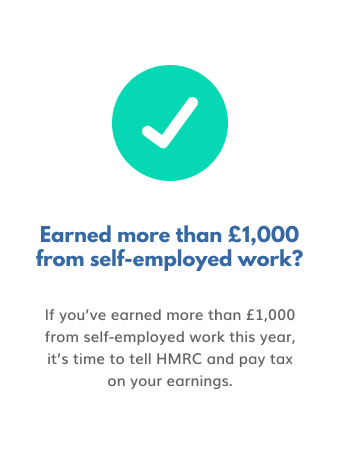
There are some exceptions to this though. The Trading Allowance means you can earn up to £1,000 of self-employment income in a tax year before you need to tell HMRC or start paying tax on it.

Is Self Assessment just for self-employed people?
Self Assessment isn’t just for people who run a business. You might still need to register even if you’re not self-employed. For instance, if you’re a shareholder and receive money from dividend payments.
You may need to register for Self Assessment if you:
- Earn more than £1,000 from self-employment as a sole trader
- Are a partner in a business partnership
- Receive dividend payments as a shareholder
- Rent out a property
- Receive other income from overseas, or from savings, investments, tips, or commission
- Get Child Benefit, and earn more than £60,000 (known as the High Income Child Benefit Charge)
You can use HMRC’s online tool to check if you need to submit a tax return.
Do I need to submit a Self Assessment return if I don’t make a profit?
Once you register for Self Assessment you’ll usually need to continue submitting returns unless you tell HMRC you no longer need to, even if you don’t make a profit one year. You might receive a penalty if you don’t submit a tax return and HMRC are expecting one!
Continue to submit your tax return even if you don’t have any income at all to report, or if you make a loss. In fact, reporting a loss can be quite useful in other ways because you may be able to carry it forward to the following tax year, and offset it against any profits in order to reduce your tax bill!
How do I submit a Self Assessment return for someone who has died?
The Tell Us Once service helps you to report a death to most government organisations and services in one go, including HMRC. If a Self Assessment tax return needs to be submitted on behalf of the person who died, HMRC will write to you to explain what happens next.
How do I register for Self Assessment?
You can register for Self Assessment online using your Government Gateway account. It’s usually fairly straightforward, though the process is slightly different depending on whether you’re registering as a sole trader, or for another reason such as to register a partnership.
Is there a deadline for registering?
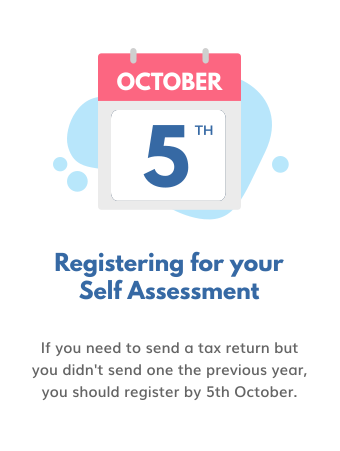
If you need to register for Self Assessment, the deadline to sign up is 5th October in your second tax year of trading. For example, if you started trading in February 2026, your first tax year is 2025/26 so you’ll need to submit a return to cover this period, and must make sure you register by 5th October 2026 at the latest.
What happens after I register?
HMRC will send you a Unique Taxpayer Reference (UTR) number within 10 working days. Keep this safe! You’ll need it each time you submit a Self Assessment tax return and to avoid issues logging in to your account.
It’s a good idea to set a reminder for submitting your tax return too.
Can I do my own Self Assessment tax return?
Yes, you can! There are no rules against completing and submitting your own Self Assessment tax return. Some people prefer to ask an accountant to do it for them to make sure they claim any tax relief they’re eligible for, but it’s not a requirement.
Registering an agent
If you do decide to get help with Self Assessment, you can authorise an agent to handle your tax affairs for you, such as a tax advisor or an accountant who meets HMRC’s standard for agents.
You can also appoint a friend or relative to be a ‘trusted helper’. Just remember you’ll still be responsible for your own tax, including submitting your return and paying the bill!
How do I complete a Self Assessment tax return?
You can complete your Self Assessment return online by signing in with your Unique Taxpayer Reference (UTR) number. The process starts with a series of questions about what type of income you need to report, and answering these will make sure you fill out the correct sections of the return.
If you prefer to submit a paper return you can download this and any supplementary pages from the HMRC website. The form will include instructions about where to send your form once it’s complete.
Which supplementary pages do I need to complete?
You can use the main Self Assessment tax return to report your income and to claim tax relief on your expenses, but if you submit a paper return you might also need to complete supplementary pages to tell HMRC about other types of income.
| Form Name | Use It To Report… | Description |
| SA101 | Additional information | Report less common types of income such as compensation or royalty payments |
| SA102 | Income from employment or as a director | Use a separate form to tell HMRC about each source of income you receive as an employee or a company director. You won’t need to pay tax on it again if this has already been deducted through payroll. |
| SA103 | Self-employment income | Use a separate form to report each source of self-employed income. |
| SA104 | Partnership income | Tell HMRC about your share of the income as an individual partner in a partnership. |
| SA105 | Property income | Report income you receive from property, furnished lettings, or land in the UK. |
| SA106 | Foreign income or gains | Complete this form to tell HMRC about foreign income or gains, and to claim foreign tax credit relief. |
| SA108 | Capital Gains | Declare any Capital Gains you get in a tax year. |
| SA109 | Non-UK or dual resident | Record your tax residence status, and claim any allowances as a non-UK resident. |
What information do I need to include on my Self Assessment tax return?
You’ll normally need to include the details of each source of income you received in that tax year, as well as information about any tax relief or allowances you’re claiming against them.
This is one of the reasons why good bookkeeping is so important for businesses! Not only does it help you to monitor the financial performance of your business, but it also makes it much easier to provide the information you need for your tax return.
When should I submit my Self Assessment tax return?
You can submit a Self Assessment tax return following the end of the tax year it relates to; just make sure you submit it before the deadline!
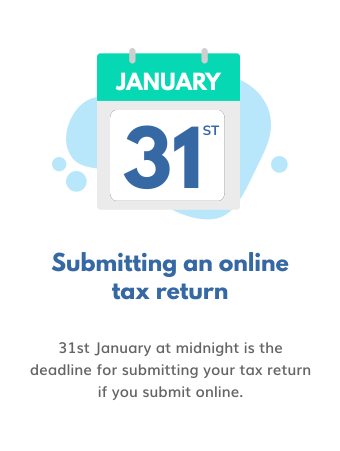
The deadline for submitting a Self Assessment return online and paying the bill is 31st January following the end of the tax year the return is for.
Key Self Assessment deadlines at a glance
This table shows the Self Assessment deadlines you need for your 2025/26 tax return.
| Action | What you need to do | Deadline |
| Register for Self Assessment | If you need to send a tax return for 2025/26 but didn't need to for the previous year, you should register for Self Assessment by this date. | 5th October 2026 |
| Submit a paper tax return | The deadline for submitting your Self Assessment tax return if you use a paper form. | Midnight, 31st October 2026 |
| Submit a tax return if you want to pay your bill through PAYE | Request that HMRC collect any tax you owe through your tax code | Midnight, 30th December 2026 |
| Submit a tax return online | This is the deadline for submitting your tax return if you submit online. | Midnight, 31st January 2027 |
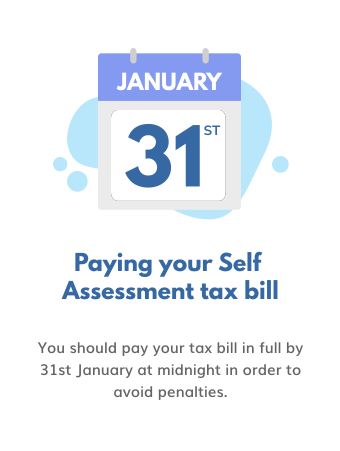
| Pay your Self Assessment tax bill | You should pay your tax bill in full by this date in order to avoid penalties. | Midnight, 31st January 2027 |
For example
If you need to submit a Self Assessment tax return for the 2025/26 tax year:
- You can submit from 6th April 2026
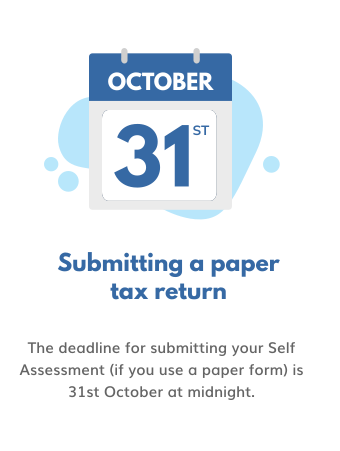
- The deadline to submit a paper return is 31st October 2026
- The deadline to submit online and to pay your bill is 31st January 2027
What happens if it’s late?
Unfortunately, HMRC take a hard stance against overdue Self Assessment tax returns or late payments, so you’ll normally receive an automatic penalty as soon as it’s one day late. The penalty will increase if more time passes, and you might also need to pay interest on the unpaid tax. Ouch!
If you had a (very good) reason for missing the deadline, you might be able to appeal as long as you submit your request within 30 days of HMRC sending the penalty notice.
What if I need to change something?
You may be able to make changes to your Self Assessment tax return even after submitting it, but the process for this depends on whether or not the deadline has passed.
How much tax will I pay?
Your Self Assessment tax bill is made up of the income tax and National Insurance you owe, along with any other types of tax you might need to pay, such as dividend tax. The National Insurance you pay on self-employed profits is separate to any NI you pay through an employer, so you might also need to pay NI as part of your Self Assessment tax bill.
The amount of tax you pay largely depends on how much you earn, and what type of income it is. For instance, the income you earn from an employer is normally subject to income tax, but if you receive dividends, you’ll pay dividend tax on them at a different rate.
It’s also worth noting you’ll only pay tax on the profits you make, not the total amount of income – so make sure you claim tax relief on all those allowable expenses! It’s yet another reason why good record keeping is so useful.
How do I pay my Self Assessment tax bill?
There are several ways you can pay what you owe for Self Assessment, including through Direct Debit, making a transfer, paying with a card, or even through your tax code if you work for an employer. Learn more about paying your Self Assessment tax bill.
Payments on account
If your tax bill comes to more than £1,000, you’ll be asked to make Payments on Account – an advance payment towards next year’s bill. The first of these advance payments is equal to half of this year’s bill, and shares the same payment deadline.
When do I need to pay my Self Assessment bill?
The deadline for paying your Self Assessment tax bill (and your first Payment on Account towards next years’ bill if this applies to you) is 31st January following the end of the tax year the payment is for. The deadline stays the same, even if you submit your tax return much earlier or use a paper form.
For example, you need to submit a tax return for 2025/26. You submit it in August 2026 just to get it out the way (well done!) and have until 31st January 2027 to pay the full balance.
Learn more about our Self Assessment tax returns services. Call 020 3355 4047, and get an instant online quote.
Want to learn more?
Subscribe to our newsletter to get accounting tips like this right to your inbox