Financial reports are important tools for managing and understanding the financial health of your business. Sometimes referred to as ‘management accounts’, they are used to track performance, make informed decisions, comply with regulations, and communicate with stakeholders.
From balance sheets to cash flow statements, each report can give unique insights into different aspects of your business’s finances, and even help you target areas which are struggling. Here we take a look at how using management accounts and financial reporting can help push your business on to the next level.
Different types of financial statements
Using different types of reports can help you analyse what’s going on in your business, so it’s useful to understand what each of these financial statements can show you. The most common types of reports are:
- Balance sheet
- Income statement (sometimes known as a profit and loss statement)
- Cash flow statement
The diagram below shows how each of these reports fits together.
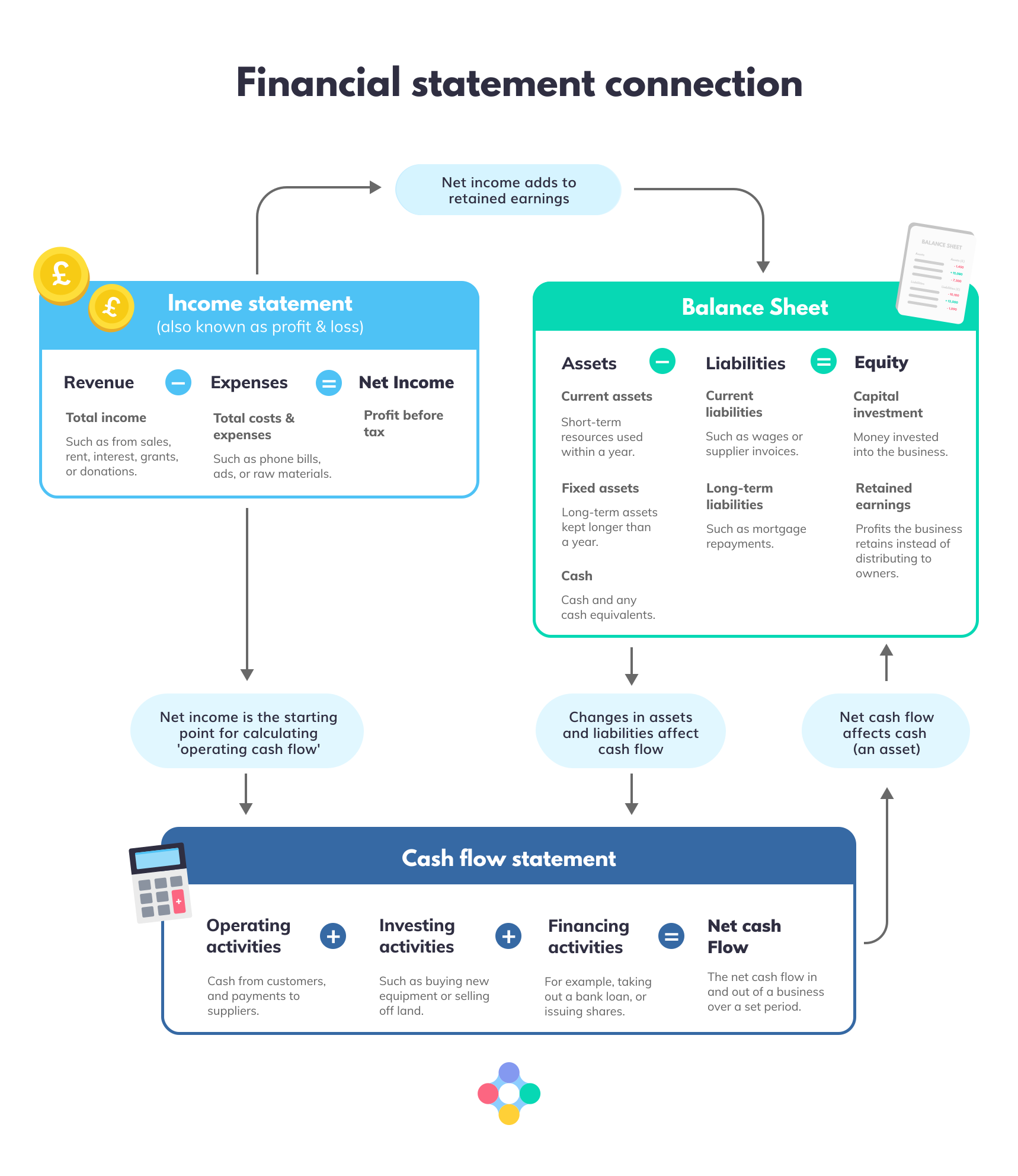
There are other reports you might use too, such as an aged debtors report to show you who owes the business money (so you’ll know where to direct those follow-up messages!).
Balance sheet
Your balance sheet provides a snapshot of your business’s financial position at a specific point in time. It includes a summary of:
Income statement (profit and loss statement)
An income statement, also known as a profit and loss statement, is a financial report that gives a summary of revenues, profits, and expenses over a specific period (usually a quarter or a year).
It allows you to compare total revenues (your total income) against your total expenses to give an idea of the business’s ability to make a profit. Income statements typically also include categories such as:
- Revenue
- Cost of goods sold (also known as ‘cost of sales’)
- Gross profit
- Operating expenses
- Net income
- Earnings per share
Again, this is all really useful in assessing the profitability and financial health of your business.
Cash Flow Statement
Another key tool for monitoring the health of a business is its cash flow statement. When we talk about cash flow, it refers to how and when funds move in and out of a business.
Managing cash flow is essential for making sure there is money available to pay the bills on time. Profits are of course really important, but a healthy cash flow is what will keep your business ticking over and out of trouble.
You may have high sales and low expenses, so your profit and loss statement will look healthy. But what if also examining your cash flow report shows that you’re struggling to pay your bills on time? And if this is the case, is it down to something like late-paying customers, or the need for stricter credit agreements or using automated invoice chasing perhaps?
Statement of Changes in Equity
This type of financial report shows changes in equity over a period of time, including contributions, distributions and retained earnings. It can be particularly useful if you’re looking to reinvest in your business to help it grow.
Using financial reports to make decisions
Financial reports are the best way to help you make informed decisions in your business. This might be around which suppliers to choose, how to diversify your products, or whether you can afford to take on extra staff.
Budgeting and planning
Going through your business’s revenue, expenses and overall profitability regularly will help you identify areas in your budget which need more attention. For example, perhaps you could cut certain overhead costs like stationary, choose a cheaper supplier, or spot the opportunity to streamline a particular process.
Making better investment and tax planning decisions
Your financial reports can also help you make clearer tax planning and investment decisions as you’ll better understand the potential risks and returns before making a commitment. For example, knowing how much you can safely take out the business to put into your pension!
Boosting your cash flow reserves
Your cash flow statement is essential for tracking the timing and sources of cash coming in and out, but you can also use your financial reporting to check your costs are being met, and see how you can boost your cash reserves, in case anything unforeseen happens.
Meeting certain deadlines
You’ll need your financial reports to help you prepare and submit your tax return, plus any other reporting requirements you might have such as submitting annual accounts to Companies House if you operate a limited company.
How else are financial reports useful?
Financial reporting is also a great way to communicate to your stakeholders, including investors, lenders, suppliers, and employees. Using data allows you to back up any analysis about how well your business is performing against its key performance indicators. Any potential lenders will also likely want to see accurate and up-to-date financial information if you apply for any loans or credit.
Who can produce management accounts?
Although some business owners choose to produce their own management accounts, it’s much easier and less risky to ask your accountant to do it, or use good accounting software that includes reporting functions.
Learn more about our online accounting services for businesses. Call the team on 020 3355 4047 or get an instant quote online
Want to learn more?
Subscribe to our newsletter to get accounting tips like this right to your inbox